Delaware LLC from South Africa: 2026 guide for non-resident founders
How founders in South Africa form a Delaware LLC for $299 + Delaware state fee, one-time. Banking realities, tax-treaty status, common business patterns.

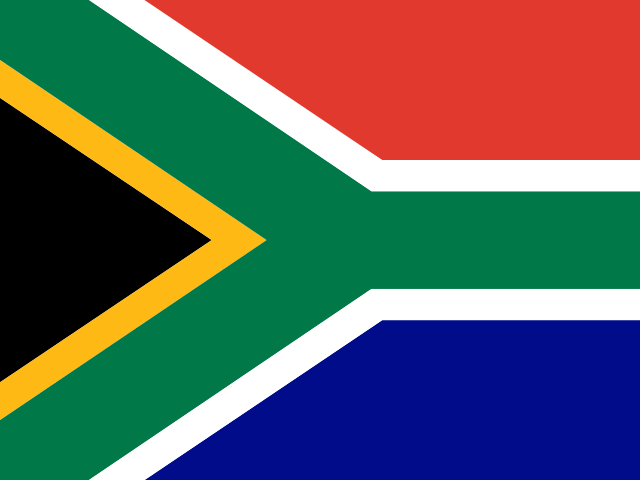

Why founders in South Africa form Delaware LLCs
Cape Town, Johannesburg, Durban-based founders dominate. South African SaaS founders often target US enterprise customers; the US LLC simplifies the contracting framework.
SARB exchange control rules apply to outward investment.
Common business types among Delewarellc's South Africa-based customer base:
- SaaS targeting US enterprise
- Agency services for US clients
- E-commerce
- Content creation
Across these business types, the US LLC plays the same structural role: it gives the founder a US-recognized business entity that US platforms (Stripe, Amazon, Upwork, Shopify Payments) onboard cleanly, plus a US-dollar bank account to receive revenue, plus a clear federal tax compliance posture via the EIN and Form 5472.
This page covers the detail specific to South Africa. For the full cross-country playbook on forming and running a US company from abroad, see our Delaware LLC for non-residents guide.
Banking realities for South Africa-based founders
Wise and Payoneer most consistent. Mercury approval is medium for South African founders; the established banking infrastructure (FNB, Standard Bank) helps applicants demonstrate financial footprint.
| Criteria | Approval rate (2026) | Notes |
|---|---|---|
| Wise Business | High | Workhorse for most non-resident founders |
| Mercury | Medium | Tightened 2025-2026; varies by business model |
| Payoneer | High | Marketplace integration (Amazon, Upwork) |
| Relay | Medium | Sub-account budgeting |
| Lili | Medium | Solo-founder focus |
Delewarellc applies to 4-5 banks per customer specifically because relying on a single bank in 2025-2026 leaves many founders waiting weeks for rejection then starting over. The full country-by-country banking pattern lives on the banking guide; the framework on multi-bank strategy is on the 4-Bank Application Strategy page.
US tax treaty status: South Africa
South Africa has a US tax treaty addressing withholding rates and permanent establishment. South African residents are taxed on worldwide income under SARS rules.
Important: tax treaty status does not eliminate the Form 5472 obligation. Foreign-owned single-member US LLCs file Form 5472 each year regardless of whether the home country has a US tax treaty. Form 5472 is an information return; the treaty affects how the underlying income is taxed, not whether the information return is filed.
Home-country taxation for South Africa residents
South African residents are taxed on worldwide income under the Income Tax Act. SARS applies a fact-specific analysis to US LLC pass-through income.
SARB exchange-control approval may be required for substantial outward funding of the US LLC.
The US side of the analysis (federal tax, Form 5472, Delaware franchise tax) is one half. The home-country side is the other, and the two need to be coordinated for the LLC structure to make sense over multiple years.
The 8-10 day formation timeline for South Africa customers
Delewarellc's formation timeline runs the same way regardless of country: Days 1-2 KYC and payment, Days 3-5 Delaware filing, Days 6-8 EIN, Days 9-10 bank applications. South Africa-specific notes:
- KYC documentation expected: South Africa passport, proof of address abroad (utility bill or bank statement from Pretoria or another South Africa city).
- Form SS-4 EIN application: filled with "Foreign" in the SSN field for the South Africa-resident responsible party.
- Bank applications: submitted to 4-5 banks weighted toward the highest-approval-rate options for South Africa.
What it costs for a South Africa-based founder
- Year 1 to Delewarellc: $407 ($297 + $110 Delaware state fee passthrough).
- Year 1 CPA fee: $200-$500 paid to a local CPA familiar with US LLC structures (typically a Pretoria-based CA or accountant).
- Year 2+: $300 Delaware franchise tax (due June 1), ~$99 registered agent renewal, $200-$500 CPA fee. Approximately $600-$900 per year ongoing.
- BOI report: Free, filed with FinCEN within 90 days of formation.
Compared to recurring-fee services that charge $1,500- $2,000 per year for the equivalent compliance support, Delewarellc's one-time pricing saves a South Africa-based founder approximately $4,000-$8,000 over 5 years.
Delewarellc's operational reality for South Africa customers
South African founders are English-native; support runs in English. SARB exchange-control coordination requires extra documentation when funding the US LLC beyond the standard annual investment allowance.
WhatsApp support is in English. The founder personally responds, typically within 2 hours, even outside US business hours. Delewarellc provides WhatsApp support in English, Bangla, Hindi, Urdu, and Arabic. No major competitor in Delaware formation offers this.
Why do South African founders form Delaware LLCs?
Founders working from Cape Town, Johannesburg, and Durban share a recurring problem. Their customers, investors, and payment processors sit in the United States, but their company sits under SARS and the South African Reserve Bank. A Delaware LLC closes that gap. It gives a Pretoria-registered or Sandton-based founder a US entity that American clients recognize on a contract, that Stripe and other US processors can onboard, and that a US bank account can attach to. For South African SaaS teams selling to US enterprise buyers, the LLC removes the friction of asking a procurement department to cut a cross-border payment to a Pty Ltd they have never heard of.
The second driver is currency. Revenue billed in US dollars and held in a US account sidesteps the immediate conversion to rand that a local-only structure forces. A founder in Stellenbosch building an agency for American clients can invoice in dollars, collect in dollars, and decide when to bring funds home rather than converting on every transaction. The Delaware LLC is not a tax shelter and it does not erase South African obligations, which we cover below. What it does is give an English-native founder a clean, internationally legible vehicle for US-facing work, formed for a one-time $299 + Delaware state fee, one-time with no annual surprises beyond the predictable Delaware franchise tax.
Which US banks actually approve South African founders?
Banking is where most country differences show up, and South Africa sits in a relatively strong position. Wise and Payoneer are the most consistent options for South African applicants, both rated high. A founder with a South African passport and a Delaware LLC plus EIN can generally open a Wise Business account and receive USD, EUR, and GBP with local-style account details. Payoneer fills a similar role and pairs well with marketplace and platform payouts. These two are the dependable backbone for a founder who wants to start collecting US-dollar revenue quickly.
Mercury approval for South African founders is rated medium rather than low, which sets the country apart from much of the continent. The established local banking infrastructure, with names like FNB and Standard Bank, helps applicants demonstrate a genuine financial footprint, and that history supports a stronger application. Relay and Lili are also medium, giving founders fallback choices if a primary application stalls. A realistic sequence looks like this:
- Open Wise or Payoneer first to start receiving USD without delay.
- Apply to Mercury once the EIN and formation documents are in hand, leaning on your South African banking history.
- Keep Relay or Lili as a backup if a primary review takes longer than expected.
What does the US tax treaty with South Africa mean for you?
South Africa has a comprehensive income tax treaty with the United States. The treaty addresses withholding rates on certain US-source income and sets out permanent establishment rules that determine when business profits become taxable in the other country. For a South African founder running a Delaware LLC, the practical value of a comprehensive treaty is reduced risk of the same income being taxed twice and a clearer framework for how cross-border payments are characterized. It does not, on its own, eliminate tax in either country.
A single-member LLC is treated as a pass-through for US purposes, so the entity itself usually does not pay US federal income tax on income that is not effectively connected to a US trade or business. The treaty and the permanent establishment analysis feed directly into that effectively-connected question. Because the facts matter, a founder should not assume a one-line answer. The treaty improves your footing compared with founders in countries that have no agreement with the US, but you should confirm your specific position with a cross-border tax adviser who can read your facts against both the treaty and SARS rules.
How does South African tax interact with a Delaware LLC?
South African residents are taxed on worldwide income under the Income Tax Act, and SARS does not stop caring about your income simply because it flows through a US entity. SARS applies a fact-specific analysis to US LLC pass-through income, which means the way you operate the company, where decisions are made, and how profits are distributed all feed into the assessment. A founder living in Johannesburg who controls and manages the LLC from there cannot treat the structure as if it sits outside the South African net. The worldwide-income principle is the anchor, and the LLC is layered on top of it rather than replacing it.
Exchange control adds a second dimension that founders in many other countries do not face. The South African Reserve Bank applies exchange-control rules to outward investment, so substantial funding of the US LLC beyond the standard annual investment allowance can require SARB approval and extra documentation. This is not a reason to avoid the structure. It is a reason to plan the timing and size of any capital you move into the entity. Keep records of how money enters and leaves the LLC, coordinate larger outward funding with your adviser and your bank, and treat SARB coordination as a normal part of operating a US company from South Africa.
What does rand and remittance friction look like in practice?
The currency is the rand, and the gap between a dollar-billing business and a rand-resident founder is real. When you invoice US clients and hold the proceeds in a USD account through Wise, Payoneer, or Mercury, you control the moment of conversion. That matters because it lets you avoid converting on a weak day purely because a payment landed. A Cape Town agency owner can hold a buffer in dollars, pay US-denominated software and contractor costs directly from that balance, and convert to rand only the portion actually needed for local living and business costs.
Remittance friction is mostly an exchange-control story rather than a banking story. Bringing dollars home is straightforward through the multi-currency accounts above, but moving large sums outward into the LLC, or repatriating in volume, intersects with SARB rules and the annual investment allowance. Practical habits help here:
- Keep a clean separation between personal funds and LLC funds so SARB documentation is easy to assemble.
- Convert deliberately rather than reflexively, using the multi-currency hold as a buffer.
- Flag any large outward transfer to your bank early so exchange-control paperwork does not delay it.
Which business types do South African founders usually run?
The common patterns for South African founders cluster around US-facing work that benefits from a US entity on the paperwork. SaaS targeting US enterprise is a strong segment, and it is the clearest case for an LLC because enterprise procurement teams prefer to contract with and pay a US company. Agency services for US clients are equally common, covering design, development, marketing, and consulting delivered from South Africa to American businesses. E-commerce and content creation round out the list, both of which lean on US payment rails and US-dollar revenue.
Across these models the founder profile is consistent. Cape Town, Johannesburg, and Durban-based founders dominate, and South African SaaS founders in particular often build for US enterprise customers, where the US LLC simplifies the contracting framework. The country's English-native workforce removes the language barrier that slows founders elsewhere, which means contracts, support, and customer conversations all run smoothly in English. The shared thread is that each business type sells into the US market, collects in dollars, and uses the Delaware LLC as the recognizable counterparty that American customers and platforms expect to see.
How long does formation take from the South African timezone?
South Africa sits two hours ahead of UTC, which puts the working day comfortably ahead of US business hours rather than out of sync with them. The Certificate of Formation in Delaware costs $110 in state fees and is processed by the state quickly once filed. The longer wait is the EIN. For a foreign-owned LLC the EIN is obtained free from the IRS using Form SS-4, and the realistic turnaround is roughly 8 to 10 business days because the application route for applicants without a US Social Security Number is handled outside the instant online system.
For a South African founder the timezone is an advantage, not a complication. A founder sending documents in the Johannesburg morning will often have them reviewed within the same US business day rather than waiting an extra cycle, which keeps the process moving. A practical timeline looks like this:
- Formation filing with Delaware: fast, often within a small number of business days.
- EIN via Form SS-4: roughly 8 to 10 business days for a foreign-owned single-member LLC.
- Bank account opening: begin with Wise or Payoneer as soon as the EIN arrives, then add Mercury.
What documents do South African founders need to prepare?
The document set is lighter than most founders expect, and South Africans are well placed because the standard forms are in English. You need a valid passport for identity, a physical residential address in South Africa, and the chosen name for the LLC. There is no requirement to travel, no need for a US address of your own, and no notarized local paperwork to file with Delaware to get started. The formation itself runs on the Certificate of Formation, and the EIN runs on Form SS-4, both of which are prepared as part of the process rather than gathered in advance from a South African authority.
Where extra documentation appears is on the South African side rather than the US side. If you intend to fund the LLC with meaningful capital from a South African source, prepare for SARB exchange-control coordination, which can require additional paperwork beyond the standard annual investment allowance. Keeping organized records from day one makes this painless:
- A clear record of the source of any funds moved into the LLC.
- Bank statements that demonstrate your South African financial footprint, useful for Mercury and for SARB.
- Copies of your formation documents and EIN letter, kept for both US filings and SARS records.
What are the annual filings a South African owner cannot skip?
Two recurring US obligations matter, and missing them is expensive. The first is the Delaware franchise tax, a flat $300 due on June 1 each year for an LLC. It is predictable and small relative to the value of the structure, but it is not optional, and a lapse creates penalties and loss of good standing. The second is the federal filing for foreign-owned single-member LLCs. Such an LLC must file Form 5472 together with a pro forma Form 1120 each year, and the penalty for failing to file is $25,000. This is a paperwork obligation rather than a tax bill in most pass-through cases, but the penalty makes it the filing a South African owner must never overlook.
There is one piece of good news that removes a worry founders sometimes carry over from older guidance. Beneficial ownership information reporting under the Corporate Transparency Act no longer applies to US-formed LLCs. Under the FinCEN Interim Final Rule of March 26, 2025, domestic entities are exempt, so there is no 90-day BOI filing requirement and no $591-per-day penalty hanging over a Delaware LLC owned from South Africa. The filings that remain are the franchise tax and the Form 5472 plus pro forma 1120 pair, alongside whatever SARS requires of you as a South African resident on your worldwide income.
What mistakes do South African founders make most often?
The most common mistake is assuming the Delaware LLC removes South African tax exposure. It does not. SARS taxes residents on worldwide income, and pass-through income from the LLC is assessed on a fact-specific basis, so a founder who treats the US entity as invisible to SARS is setting up a future problem. The second mistake is ignoring exchange control until a large transfer is already in motion. SARB rules on outward investment and the annual investment allowance need to be planned around, not discovered after a payment is blocked or queried.
Other errors are operational and avoidable. Founders sometimes delay the EIN-dependent bank application and lose weeks of dollar collection, when opening Wise or Payoneer immediately would have kept revenue flowing. Some forget the June 1 franchise tax or treat the Form 5472 filing as optional, then face a $25,000 penalty exposure that dwarfs the cost of compliance. A short checklist prevents most of these:
- Confirm your SARS position on LLC income with a cross-border adviser early.
- Plan any large LLC funding around SARB exchange-control rules before you transfer.
- Open a multi-currency account as soon as the EIN arrives rather than waiting for Mercury.
- Diary the June 1 franchise tax and the annual Form 5472 filing so neither slips.
Is a Delaware LLC the right fit for a founder in South Africa?
For a South African founder whose customers, processors, or investors are in the United States, a Delaware LLC is a strong fit. The country's comprehensive US tax treaty, English-native workforce, and established banking history combine to make the structure smoother to set up and operate than it is for founders in many other markets. Wise and Payoneer give a reliable on-ramp to dollar revenue, Mercury is a realistic medium-approval target rather than a long shot, and the timezone keeps the founder in step with US business hours rather than behind them.
The fit is weakest only when a founder expects the structure to do something it cannot, such as erasing SARS obligations or bypassing exchange control. Treated honestly, as a US entity that handles US-facing contracts, banking, and revenue while you remain a compliant South African resident, the LLC earns its place. The cost is a one-time $299 + Delaware state fee, one-time to form, a flat $300 Delaware franchise tax each June, and the discipline to keep the Form 5472 filing current. For a Cape Town SaaS team or a Durban agency selling into the US, that is a modest price for a clean, recognizable home for the American side of the business.
Related guides for this country
- US business banking from South Africa
- South Africa, US tax treaty
- Sending profits home to South Africa
- Delaware LLC from Johannesburg
- Delaware LLC from Cape Town
- Delaware LLC cost breakdown
- Dissolve a Delaware LLC (step by step)
- US business banking guide
- Delaware LLC from Ghana
- Delaware LLC from Morocco
- Delaware LLC from Argentina
- Delaware LLC from Colombia
- Delaware LLC from Thailand
- Delaware LLC from Malaysia
Frequently asked questions
Can a South Africa resident form a Delaware LLC without visiting the US?
Yes. South Africa residents form a Delaware LLC entirely online, with no US visit, SSN, or US address required. You need a passport for identity verification, an EIN, and a Delaware registered agent, which Delewarellc includes for $297 plus the $110 Delaware state fee.
Does the US-South Africa tax treaty affect a Delaware LLC?
South Africa has a comprehensive US income tax treaty. South Africa has a US tax treaty addressing withholding rates and permanent establishment. South African residents are taxed on worldwide income under SARS rules.
Can South Africa founders open a US business bank account for a Delaware LLC?
Yes. South Africa-based founders most often use Wise Business (typical approval: high). Mercury approval runs medium and Payoneer high. Wise and Payoneer most consistent. Mercury approval is medium for South African founders; the established banking infrastructure (FNB, Standard Bank) helps applicants demonstrate financial footprint.
How are Delaware LLC profits taxed for a South Africa resident?
A Delaware LLC is a pass-through entity by default, so profits flow to you as the owner rather than being taxed at the company level in Delaware. South African residents are taxed on worldwide income under the Income Tax Act. SARS applies a fact-specific analysis to US LLC pass-through income. SARB exchange-control approval may be required for substantial outward funding of the US LLC.
What is IRS Form 5472 and who must file it?
Form 5472 is required annually from foreign-owned single-member US LLCs treated as disregarded entities. The penalty for not filing is $25,000 per occurrence. Form 5472 must be filed with pro forma Form 1120 by April 15 (extendable to October 15).
How long does Delaware LLC formation take?
Standard Delaware LLC formation takes approximately 5-10 business days through the state portal. Expedited filing is available for $50-$1,000 above the standard fee for same-day or 24-hour processing. Delewarellc's full formation process including EIN and bank account applications takes 8-10 business days end to end.
Related resources
Form your Delaware LLC today
$299 + Delaware state fee, one-time. 8-10 days. One-time pricing.