Delaware LLC from Malaysia: 2026 guide for non-resident founders
How founders in Malaysia form a Delaware LLC for $299 + Delaware state fee, one-time. Banking realities, tax-treaty status, common business patterns.

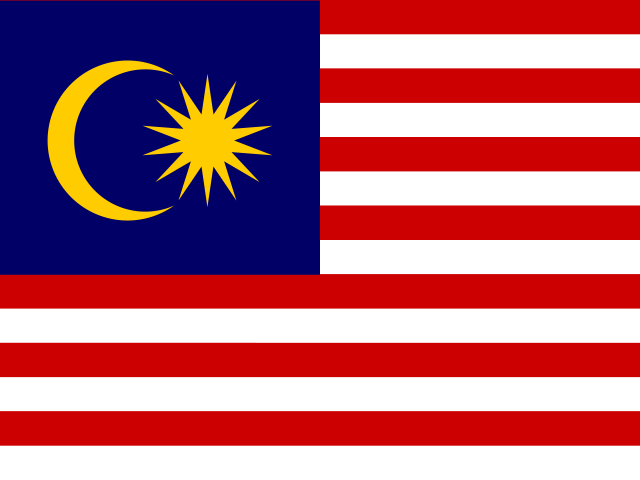

Why founders in Malaysia form Delaware LLCs
Kuala Lumpur, Penang, Johor Bahru-based founders dominate. Malaysia's territorial tax system makes US LLC structures particularly favorable; foreign-source income kept offshore is generally not taxed.
Common business types among Delewarellc's Malaysia-based customer base:
- SaaS targeting Southeast Asia and US
- E-commerce
- Software outsourcing
- Cross-border services
Across these business types, the US LLC plays the same structural role: it gives the founder a US-recognized business entity that US platforms (Stripe, Amazon, Upwork, Shopify Payments) onboard cleanly, plus a US-dollar bank account to receive revenue, plus a clear federal tax compliance posture via the EIN and Form 5472.
This page covers the detail specific to Malaysia. For the full cross-country playbook on forming and running a US company from abroad, see our Delaware LLC for non-residents guide.
Banking realities for Malaysia-based founders
Wise and Payoneer most consistent. Mercury approval is medium-high for Malaysian founders due to mature banking infrastructure.
| Criteria | Approval rate (2026) | Notes |
|---|---|---|
| Wise Business | High | Workhorse for most non-resident founders |
| Mercury | Medium | Tightened 2025-2026; varies by business model |
| Payoneer | High | Marketplace integration (Amazon, Upwork) |
| Relay | Medium | Sub-account budgeting |
| Lili | Medium | Solo-founder focus |
Delewarellc applies to 4-5 banks per customer specifically because relying on a single bank in 2025-2026 leaves many founders waiting weeks for rejection then starting over. The full country-by-country banking pattern lives on the banking guide; the framework on multi-bank strategy is on the 4-Bank Application Strategy page.
US tax treaty status: Malaysia
Malaysia does not have a comprehensive income tax treaty in force with the United States, so US-source FDAP income faces the default 30% withholding.
Malaysian residents are taxed on Malaysian-source income (territorial system); foreign income is generally not taxed unless remitted. Confirm specifics with a Malaysian tax adviser.
Important: tax treaty status does not eliminate the Form 5472 obligation. Foreign-owned single-member US LLCs file Form 5472 each year regardless of whether the home country has a US tax treaty. Form 5472 is an information return; the treaty affects how the underlying income is taxed, not whether the information return is filed.
Home-country taxation for Malaysia residents
Malaysian residents are taxed on Malaysian-source income only (territorial system). Foreign-source income is generally exempt unless remitted to Malaysia.
This makes the US LLC structure tax-favorable when revenue stays in the US LLC.
The US side of the analysis (federal tax, Form 5472, Delaware franchise tax) is one half. The home-country side is the other, and the two need to be coordinated for the LLC structure to make sense over multiple years.
The 8-10 day formation timeline for Malaysia customers
Delewarellc's formation timeline runs the same way regardless of country: Days 1-2 KYC and payment, Days 3-5 Delaware filing, Days 6-8 EIN, Days 9-10 bank applications. Malaysia-specific notes:
- KYC documentation expected: Malaysia passport, proof of address abroad (utility bill or bank statement from Kuala Lumpur or another Malaysia city).
- Form SS-4 EIN application: filled with "Foreign" in the SSN field for the Malaysia-resident responsible party.
- Bank applications: submitted to 4-5 banks weighted toward the highest-approval-rate options for Malaysia.
What it costs for a Malaysia-based founder
- Year 1 to Delewarellc: $407 ($297 + $110 Delaware state fee passthrough).
- Year 1 CPA fee: $200-$500 paid to a local CPA familiar with US LLC structures (typically a Kuala Lumpur-based CA or accountant).
- Year 2+: $300 Delaware franchise tax (due June 1), ~$99 registered agent renewal, $200-$500 CPA fee. Approximately $600-$900 per year ongoing.
- BOI report: Free, filed with FinCEN within 90 days of formation.
Compared to recurring-fee services that charge $1,500- $2,000 per year for the equivalent compliance support, Delewarellc's one-time pricing saves a Malaysia-based founder approximately $4,000-$8,000 over 5 years.
Delewarellc's operational reality for Malaysia customers
Most Malaysian founders are English-native. Support runs in English.
WhatsApp support is in English (Malay + Mandarin bilingual) and English. The founder personally responds, typically within 2 hours, even outside US business hours. Delewarellc provides WhatsApp support in English, Bangla, Hindi, Urdu, and Arabic. No major competitor in Delaware formation offers this.
Why do founders in Kuala Lumpur and Penang form Delaware LLCs?
Malaysia runs a territorial tax system, and that single fact shapes almost every decision a founder in Kuala Lumpur, Penang, or Johor Bahru makes about where to hold US-facing revenue. Malaysian residents are taxed on Malaysian-source income, while foreign-source income is generally exempt unless it is remitted into Malaysia. A Delaware LLC that earns from US customers, US ad networks, or US marketplaces sits cleanly outside the Malaysian tax base for as long as that money stays inside the US structure. For a Penang SaaS founder billing American subscribers in dollars, the LLC becomes a holding point for foreign-source income rather than a second layer of tax exposure.
The second reason is access. A Malaysian sole proprietor or Sdn Bhd cannot easily open a US-resident-grade payment account, and Stripe, several US ad platforms, and many American B2B buyers prefer to transact with a US entity that carries a real EIN and a US business address. Forming a Delaware LLC closes that gap without requiring the founder to leave Kuala Lumpur. The state charges $110 for the Certificate of Formation, the entity carries a flat $300 annual franchise tax due each June 1, and the federal EIN is free through Form SS-4. Against that backdrop, founders here treat the LLC as infrastructure for reaching the US market, not as a way to dodge anything at home.
What does Malaysia's comprehensive US tax treaty actually change?
Malaysia holds a comprehensive income tax treaty with the United States that addresses withholding rates between the two countries. For most Malaysian founders running a single-member Delaware LLC, the practical effect is narrower than the headline suggests, because a single-member LLC is a disregarded entity for US federal tax. Income that is not effectively connected to a US trade or business, and that is not US-source fixed or determinable annual income flowing to the foreign owner, generally does not trigger US income tax for a non-resident owner who has no US presence. The treaty matters most when there is genuine US-source passive income in the picture, where it can reduce the standard 30% withholding on certain payment types.
What the treaty does not do is exempt a Malaysian owner from US filing obligations tied to the structure itself. A foreign-owned single-member LLC must file Form 5472 together with a pro forma Form 1120 every year, and the penalty for missing that filing is $25,000. The treaty has no bearing on that requirement. Founders in Kuala Lumpur sometimes assume a favorable treaty means lighter paperwork, and the opposite is closer to the truth: the treaty governs tax rates on specific income flows, while the 5472 obligation is an informational filing that applies regardless of whether any US tax is owed. Treat the two as separate tracks.
Which US banks approve Malaysian founders most reliably?
Malaysia benefits from one of the more mature banking footprints in Southeast Asia, and that maturity shows in approval outcomes. Wise and Payoneer are the most consistent options for Malaysian founders, both rated high, because they are built to onboard non-residents and accept a Malaysian passport, a Malaysian proof of address, and the LLC's EIN documentation without friction. Mercury sits at medium-high for Malaysian applicants, stronger than for many neighboring countries, in part because Kuala Lumpur founders tend to present clean documented US business activity and English-language records. Relay and Lili round out the field at medium, useful as secondary or backup accounts rather than first choices.
- Wise (High): reliable first account for receiving USD and converting to MYR when needed.
- Payoneer (High): strong for marketplace and platform payouts directed at the LLC.
- Mercury (Medium-high): viable primary account when US business activity is documented.
- Relay (Medium): workable secondary, often paired with accounting tools.
- Lili (Medium): backup option for simpler single-member setups.
A practical pattern many Malaysian founders use is to open Wise or Payoneer first to start receiving revenue quickly, then apply to Mercury once there is a short history of inbound US payments to point to. Because all of these accounts are opened remotely, a founder in Penang or Johor Bahru never needs to travel. The EIN should be in hand before applying, since every one of these providers asks for it, and a US business address from the registered agent satisfies the address field on the application forms.
How does currency and remittance friction work for MYR-based founders?
Revenue arrives in US dollars, the founder lives in a ringgit economy, and the gap between those two creates the main operational question. Holding earnings in USD inside Wise, Payoneer, or Mercury lets a Malaysian founder pay US suppliers, software subscriptions, and contractors directly in dollars, avoiding a round trip through MYR conversion. This is not only a cost decision but a tax one, because Malaysia's remittance rule means foreign-source income kept offshore is generally not pulled into the Malaysian tax base until it is brought into the country. Keeping a working balance in the US accounts is therefore both cheaper and cleaner.
When money does need to reach Malaysia, Wise typically offers the most transparent conversion into MYR, with mid-market rates and visible fees, which is why so many founders here route personal draws through it. The discipline that separates smooth operators from stressed ones is keeping business and personal flows apart: the LLC's accounts handle US revenue and US expenses, and only deliberate transfers move into a Malaysian personal account as the founder chooses to remit. Documenting each remittance matters, because the timing and amount of money brought into Malaysia is exactly what the territorial system looks at. A founder who tracks remittances carefully keeps the structure's tax advantage intact.
What home-country tax obligations remain in Malaysia?
The territorial system is generous, but it is not the same as having no obligations. A Malaysian tax resident still files with the Inland Revenue Board, and the question that governs LLC income is whether that income is Malaysian-source or foreign-source, and whether any of it has been remitted into Malaysia. Income earned by the Delaware LLC from US and international customers is generally foreign-source. Kept offshore in the LLC's US accounts, it generally stays outside the Malaysian tax net. The moment a founder remits a portion to live on in Kuala Lumpur, that remitted amount is what enters the conversation with the IRB.
Founders should be careful about the line between operating a US LLC and actually conducting business activity inside Malaysia. If the substantive work is performed in Malaysia, a Malaysian tax authority may view some of the income as Malaysian-source regardless of where the bank account sits, and the LLC label alone does not change where work physically happens. Because the interaction between US disregarded-entity treatment, the treaty, and Malaysian sourcing rules can turn on specifics, a Malaysian founder with meaningful revenue is well served by a short consultation with a local tax adviser who understands cross-border structures. The goal is to confirm sourcing and remittance treatment before filing, not after a notice arrives.
What business types do Malaysian founders usually run through the LLC?
The Malaysian founder base skews toward digital and cross-border models that earn naturally in dollars. SaaS products targeting both Southeast Asia and the US are common, often built by Kuala Lumpur and Penang engineering teams who want a US entity to sign American customers and run Stripe. E-commerce sellers list on US marketplaces and route payouts to the LLC. Software outsourcing shops invoice US and European clients under a US business name that lends credibility to proposals. Cross-border service providers, from design studios to consultancies, use the LLC as the contracting entity for international work.
- SaaS aimed at Southeast Asian and US markets, billed in USD through Stripe.
- E-commerce selling into US marketplaces with payouts to the LLC.
- Software outsourcing and development for US and European clients.
- Cross-border professional and creative services contracted under the US entity.
What these models share is that the customer and the money are outside Malaysia, which is exactly the situation the territorial system rewards. A single-member Delaware LLC fits all of them because it is simple to form, simple to bank, and treated as a disregarded entity for US tax. Penang and Johor Bahru founders in particular tend to run lean teams where one person owns the entity and a few contractors deliver the work, and the single-member structure maps onto that cleanly without the overhead of a multi-member operating agreement or partnership filing.
How long does formation take from the Malaysian timezone?
Malaysia runs eight hours ahead of US Eastern time, which works in a founder's favor more often than against it. Filing the Certificate of Formation in Delaware is the fast step, frequently completing within a business day or two depending on the state queue. A Malaysian founder who submits documents in the evening Kuala Lumpur time effectively hands the work to the US business day while sleeping, and updates often land by the next morning local time. The registered agent and US address are arranged as part of the same setup, so nothing about formation requires the founder to be awake during US hours.
The longer leg is the EIN. The IRS issues the EIN for free through Form SS-4, and for foreign founders without a US Social Security Number the application generally clears in roughly eight to ten business days. That window, not the Delaware filing, is what sets the real start date for banking, because Wise, Payoneer, and Mercury all ask for the EIN. A realistic sequence for a Kuala Lumpur founder is: entity formed within days, EIN in hand inside two weeks, first bank account opened shortly after, and revenue flowing within roughly three to four weeks of starting. Planning around the EIN wait, rather than expecting same-week banking, keeps expectations accurate.
What documents does a Malaysian founder need to get started?
The document load is lighter than most first-timers expect, and a Malaysian founder rarely needs anything notarized or apostilled to form the entity. The core requirement is identity and a few decisions about the company itself. Because most Malaysian founders are English-native, the forms and correspondence run in English without translation, which removes a step that founders from non-English jurisdictions sometimes face.
- A valid Malaysian passport as the primary identity document.
- A chosen company name and the LLC's intended business activity.
- A Malaysian residential address for the application records.
- An email and phone for IRS and registered-agent correspondence.
- The registered agent and US business address, arranged during setup.
Banking applications later ask for a little more: the filed Certificate of Formation, the EIN confirmation, and sometimes a short description of the business and expected transaction flow. Mercury in particular looks for evidence of genuine US-facing activity, so a Penang or Kuala Lumpur founder who can point to a website, customer contracts, or marketplace accounts strengthens the application. Keeping a tidy folder with the formation document, the EIN letter, the passport scan, and a one-paragraph business summary means every bank application after the first reuses the same materials rather than starting from scratch.
What mistakes do Malaysian founders make most often?
The most common and most expensive mistake is ignoring Form 5472. Because Malaysia's territorial system can leave a founder owing little or nothing on foreign-source income, some assume there is nothing to file in the US either. That is wrong: a foreign-owned single-member LLC must file Form 5472 with a pro forma Form 1120 every year, and the penalty for missing it is $25,000, owed entirely independently of whether any US tax is due. A founder who treats the LLC as a fully passive offshore container and skips the annual filing is exposed to a penalty that dwarfs every other cost of running the entity.
Two other errors recur. The first is mishandling remittances by mixing LLC funds with personal Malaysian accounts, which blurs the foreign-source line that the territorial system depends on and makes the IRB conversation harder than it needs to be. Keeping US revenue inside the LLC's US accounts and remitting deliberately preserves the structure's advantage. The second is misreading the Beneficial Ownership Information rule. Under the FinCEN Interim Final Rule of March 26, 2025, US-formed entities are exempt from BOI reporting, so there is no 90-day requirement and no $591-per-day penalty for a domestic LLC. Malaysian founders sometimes chase a BOI deadline that does not apply to them, or pay third parties to file something unnecessary. Knowing which obligations are real, the $300 franchise tax and the 5472, and which no longer apply keeps the structure both compliant and inexpensive at $297 one-time pricing.
Related guides for this country
- US business banking from Malaysia
- Malaysia, US tax treaty
- Sending profits home to Malaysia
- Delaware LLC from Kuala Lumpur
- Delaware LLC cost breakdown
- Dissolve a Delaware LLC (step by step)
- US business banking guide
- Delaware LLC from Sri Lanka
- Delaware LLC from Jordan
- Delaware LLC from Lebanon
- Delaware LLC from Tunisia
- Delaware LLC from Russia
- Delaware LLC from Ukraine
- Delaware LLC from Poland
Frequently asked questions
Can a Malaysia resident form a Delaware LLC without visiting the US?
Yes. Malaysia residents form a Delaware LLC entirely online, with no US visit, SSN, or US address required. You need a passport for identity verification, an EIN, and a Delaware registered agent, which Delewarellc includes for $297 plus the $110 Delaware state fee.
Does the US-Malaysia tax treaty affect a Delaware LLC?
There is no comprehensive US-Malaysia income tax treaty. Malaysia does not have a comprehensive income tax treaty in force with the United States, so US-source FDAP income faces the default 30% withholding. Malaysian residents are taxed on Malaysian-source income (territorial system); foreign income is generally not taxed unless remitted. Confirm specifics with a Malaysian tax adviser.
Can Malaysia founders open a US business bank account for a Delaware LLC?
Yes. Malaysia-based founders most often use Wise Business (typical approval: high). Mercury approval runs medium and Payoneer high. Wise and Payoneer most consistent. Mercury approval is medium-high for Malaysian founders due to mature banking infrastructure.
How are Delaware LLC profits taxed for a Malaysia resident?
A Delaware LLC is a pass-through entity by default, so profits flow to you as the owner rather than being taxed at the company level in Delaware. Malaysian residents are taxed on Malaysian-source income only (territorial system). Foreign-source income is generally exempt unless remitted to Malaysia. This makes the US LLC structure tax-favorable when revenue stays in the US LLC.
What is IRS Form 5472 and who must file it?
Form 5472 is required annually from foreign-owned single-member US LLCs treated as disregarded entities. The penalty for not filing is $25,000 per occurrence. Form 5472 must be filed with pro forma Form 1120 by April 15 (extendable to October 15).
How long does Delaware LLC formation take?
Standard Delaware LLC formation takes approximately 5-10 business days through the state portal. Expedited filing is available for $50-$1,000 above the standard fee for same-day or 24-hour processing. Delewarellc's full formation process including EIN and bank account applications takes 8-10 business days end to end.
Related resources
Form your Delaware LLC today
$299 + Delaware state fee, one-time. 8-10 days. One-time pricing.