Delaware LLC from Spain: 2026 guide for non-resident founders
How founders in Spain form a Delaware LLC for $299 + Delaware state fee, one-time. Banking realities, tax-treaty status, common business patterns.

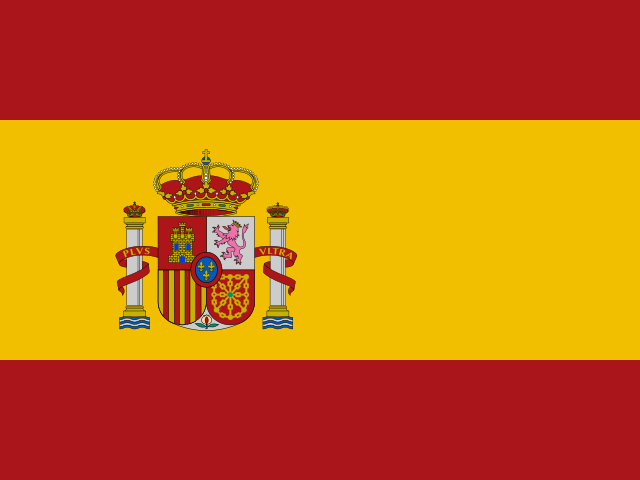

Why founders in Spain form Delaware LLCs
Barcelona, Madrid, Valencia-based founders dominate. Many Spanish founders serve both LATAM (Spanish-language) and US markets.
Common business types among Delewarellc's Spain-based customer base:
- SaaS targeting LATAM and US
- Agency services
- Content creation
- E-commerce
Across these business types, the US LLC plays the same structural role: it gives the founder a US-recognized business entity that US platforms (Stripe, Amazon, Upwork, Shopify Payments) onboard cleanly, plus a US-dollar bank account to receive revenue, plus a clear federal tax compliance posture via the EIN and Form 5472.
This page covers the detail specific to Spain. For the full cross-country playbook on forming and running a US company from abroad, see our Delaware LLC for non-residents guide.
Banking realities for Spain-based founders
Major banks generally approve Spanish founders.
| Criteria | Approval rate (2026) | Notes |
|---|---|---|
| Wise Business | High | Workhorse for most non-resident founders |
| Mercury | High | Tightened 2025-2026; varies by business model |
| Payoneer | High | Marketplace integration (Amazon, Upwork) |
| Relay | Medium | Sub-account budgeting |
| Lili | Medium | Solo-founder focus |
Delewarellc applies to 4-5 banks per customer specifically because relying on a single bank in 2025-2026 leaves many founders waiting weeks for rejection then starting over. The full country-by-country banking pattern lives on the banking guide; the framework on multi-bank strategy is on the 4-Bank Application Strategy page.
US tax treaty status: Spain
Spain has a US tax treaty including reduced withholding on dividends and interest. Spanish residents are taxed on worldwide income.
Important: tax treaty status does not eliminate the Form 5472 obligation. Foreign-owned single-member US LLCs file Form 5472 each year regardless of whether the home country has a US tax treaty. Form 5472 is an information return; the treaty affects how the underlying income is taxed, not whether the information return is filed.
Home-country taxation for Spain residents
Spanish residents taxed on worldwide income. Agencia Tributaria applies specific rules to US LLC structures. Beckham Law tax regime may apply for some founders.
The US side of the analysis (federal tax, Form 5472, Delaware franchise tax) is one half. The home-country side is the other, and the two need to be coordinated for the LLC structure to make sense over multiple years.
The 8-10 day formation timeline for Spain customers
Delewarellc's formation timeline runs the same way regardless of country: Days 1-2 KYC and payment, Days 3-5 Delaware filing, Days 6-8 EIN, Days 9-10 bank applications. Spain-specific notes:
- KYC documentation expected: Spain passport, proof of address abroad (utility bill or bank statement from Madrid or another Spain city).
- Form SS-4 EIN application: filled with "Foreign" in the SSN field for the Spain-resident responsible party.
- Bank applications: submitted to 4-5 banks weighted toward the highest-approval-rate options for Spain.
What it costs for a Spain-based founder
- Year 1 to Delewarellc: $407 ($297 + $110 Delaware state fee passthrough).
- Year 1 CPA fee: $200-$500 paid to a local CPA familiar with US LLC structures (typically a Madrid-based CA or accountant).
- Year 2+: $300 Delaware franchise tax (due June 1), ~$99 registered agent renewal, $200-$500 CPA fee. Approximately $600-$900 per year ongoing.
- BOI report: Free, filed with FinCEN within 90 days of formation.
Compared to recurring-fee services that charge $1,500- $2,000 per year for the equivalent compliance support, Delewarellc's one-time pricing saves a Spain-based founder approximately $4,000-$8,000 over 5 years.
Delewarellc's operational reality for Spain customers
Most Spanish tech founders are English-comfortable. Support in English; Spanish translation via partner network when needed.
WhatsApp support is in Spanish (English support) and English. The founder personally responds, typically within 2 hours, even outside US business hours. Delewarellc provides WhatsApp support in English, Bangla, Hindi, Urdu, and Arabic. No major competitor in Delaware formation offers this.
Why do founders in Spain form a Delaware LLC?
Spanish founders sit in an unusual position. From Barcelona, Madrid, and Valencia they often serve two markets at once: the Spanish-speaking LATAM audience and the US market that pays in dollars and signs contracts with US counterparties. A Delaware LLC gives that kind of founder a clean US-facing legal vehicle without forcing them to relocate or open a US branch of a Spanish sociedad limitada. The structure is recognized by US payment processors, US SaaS marketplaces, and US clients who prefer to contract with a US entity rather than a foreign company they have never heard of. For a founder in Spain whose customers are spread between Mexico City, Bogotá, and San Francisco, the Delaware LLC becomes the contracting layer that everyone upstream already understands.
The cost math also favors Delaware. Formation runs on a $110 Certificate of Formation filed with the Delaware Division of Corporations, and the state charges a $300 flat annual franchise tax due each June 1 regardless of revenue. There is no minimum capital requirement and no notarized share capital deposit, which is a sharp contrast to the capital and notary steps a Spanish founder associates with incorporating at home. Delewarellc handles the filing for a $297 one-time price, and the EIN application via Form SS-4 is free directly from the IRS. For a Spanish solo founder or a small Barcelona team, the entire US presence can be stood up for a predictable, low fixed cost while the operating business stays in Spain.
Which banks actually approve Spanish founders?
Banking is where most non-US founders stall, so it is worth being precise about what the pattern looks like from Spain. Spanish founders generally clear US fintech account reviews well, partly because Spain is a comprehensive-treaty country with mature financial regulation and clean documentation. In practice, the major providers approve Spanish founders at a high rate, and the realistic ordering of likelihood from Spain looks like this:
- Wise: High approval. A common first account for Spanish founders because it handles EUR and USD side by side and makes converting back to a Spanish IBAN straightforward.
- Mercury: High approval. Frequently chosen by Spanish SaaS and agency founders who want a US-resident-style business account with virtual cards and API access.
- Payoneer: High approval. Useful for founders taking marketplace and platform payouts from US sources.
- Relay: Medium approval. Workable, though Spanish founders sometimes find onboarding documentation requests heavier here.
- Lili: Medium approval. More oriented to US-resident solo operators, so it is a secondary rather than primary choice from Spain.
The record for Spain notes that major banks generally approve Spanish founders, and that matches what founders report. The practical advice is to apply to Wise or Mercury first with a fully formed LLC, an EIN already issued, and a clean Spanish passport or DNI as proof of identity. Do not apply before the EIN exists, because every one of these providers asks for it. Keep a Spanish proof of address handy as well, since a utility bill or bank statement in the founder's name is a routine request. Spanish founders rarely need a US address to open these accounts, but having a consistent business name across the formation documents, the EIN letter, and the bank application removes the most common reason a review gets delayed.
What does the comprehensive US tax treaty mean for Spain?
Spain holds a comprehensive income tax treaty with the United States, and that status carries real weight for a founder structuring a Delaware LLC. The treaty includes reduced withholding on categories such as dividends and interest, which can lower the US tax friction on certain passive flows compared with a founder from a no-treaty country. Just as important, a treaty relationship signals to US banks and counterparties that Spain is a transparent, well-regulated jurisdiction, which is one quiet reason Spanish founders clear account reviews as smoothly as they do. The treaty does not exempt a Spanish founder from US filing duties, but it provides the framework that prevents the same income from being fully taxed twice.
It is important to be clear about what the treaty does not do. A single-member Delaware LLC owned by a Spanish resident is treated by default as a disregarded entity for US tax purposes, which means the LLC itself usually pays no US federal income tax on income that is not effectively connected to a US trade or business. The treaty shapes withholding and the avoidance of double taxation, but it does not change the requirement that the Spanish owner report and assess their own position correctly on both sides. Because Spain taxes residents on worldwide income, the treaty becomes the instrument a Spanish founder and their Spanish adviser use to coordinate US-source treatment with Spanish liability rather than a tool that makes either obligation disappear.
How does Spanish home-country tax interact with a US LLC?
Spanish residents are taxed on their worldwide income, and the Agencia Tributaria applies its own analysis to US LLC structures rather than accepting a US characterization at face value. This is the single most important point for a founder in Spain to internalize: forming a Delaware LLC does not move your tax residence and does not remove income from the Spanish base. If you live in Madrid and run the business from Madrid, the profits the LLC earns are generally relevant to your Spanish return, and the way Spain classifies the LLC (as transparent or as a corporate-style entity) can change how that income is reported. This is exactly the kind of question a Spanish gestor or tax adviser should confirm in writing for your specific facts before the first profitable year closes.
There is one Spain-specific wrinkle worth naming. The Beckham Law regime, the special impatriate tax treatment available to certain people who relocate to Spain, may apply to some founders and can change how foreign-source income is treated during the qualifying years. Whether it helps or is even available depends entirely on the founder's individual situation and timing, so it should never be assumed. The general rule remains: a Delaware LLC is a US legal and banking instrument, not a Spanish tax shelter, and Spanish residents should plan on the LLC's economics flowing into their Spanish position. Coordinating early with a Spanish professional, ideally one who has handled US disregarded entities, avoids the unpleasant surprise of discovering a reporting position only after the Agencia Tributaria asks about it.
What US filings does a Spanish-owned LLC have to make?
The compliance Spanish founders most often underestimate is Form 5472. A foreign-owned single-member US LLC is required to file Form 5472 together with a pro forma Form 1120 each year to report reportable transactions between the LLC and its foreign owner, such as capital the founder puts in and distributions taken out. This filing is informational rather than a tax payment in most disregarded-entity cases, but the penalty for missing it is severe: the IRS can assess $25,000 for a late or omitted Form 5472. A founder in Spain who treats the LLC as fire-and-forget after formation is exactly the person who walks into that penalty, so this belongs on the calendar from day one.
- Certificate of Formation: $110 at formation with Delaware.
- EIN via Form SS-4: free from the IRS, typically issued in roughly 8 to 10 business days for a foreign founder without a US Social Security number.
- Delaware franchise tax: $300 flat, due each June 1.
- Form 5472 with pro forma 1120: filed annually, with a $25,000 penalty for failure to file.
- BOI reporting: exempt for US-formed LLCs since the FinCEN Interim Final Rule of March 26 2025, so a domestic Delaware LLC has no 90-day beneficial-ownership filing requirement and no associated daily penalty.
That last point matters because earlier guidance circulating among European founders still warned about beneficial-ownership reporting and steep daily penalties. For a US-formed entity such as a Delaware LLC, that requirement no longer applies to domestic entities under the 2025 rule, which removes a layer of worry Spanish founders sometimes carry over from older articles. The filings that do remain are predictable and calendar-driven, which is exactly how a founder in Spain should treat them: a fixed annual rhythm rather than an open-ended risk.
How do EUR and remittance friction affect Spanish founders?
Spain is on the euro, so a Spanish founder operating a dollar-denominated US business lives with a constant currency layer between US revenue and Spanish spending. Customers in the US and LATAM pay in dollars, the Delaware LLC banks in dollars, and at some point the founder needs euros to live in Barcelona or Valencia. Every conversion is a small cost, and doing it through a traditional Spanish bank with a poor exchange rate quietly erodes margin. This is why multi-currency providers such as Wise are so popular among Spanish founders: holding USD in the US account and converting to EUR only when needed, at a transparent mid-market-style rate, keeps more of the revenue intact than repeated bank conversions would.
Remittance timing is the other half of the friction. Moving money from a US business account to a Spanish personal IBAN is routine, but founders should plan the path rather than improvise it. A clean pattern is to keep the LLC's working capital in the US account, draw owner distributions on a regular schedule, and convert to EUR in batches rather than in many small transfers that each incur fees and rate spreads. Because Form 5472 reports owner contributions and distributions, keeping these transfers documented and consistent also makes the annual US filing simpler. A Spanish founder who treats the USD-to-EUR bridge as a deliberate part of the operation, instead of an afterthought, both preserves margin and keeps the paper trail tidy.
What business types do Spanish founders usually run through a Delaware LLC?
The Spanish founder base clusters around a handful of models, and the Delaware LLC fits each of them for a slightly different reason. SaaS founders building products that target both LATAM and US customers use the LLC as the entity that signs up for US payment rails and enterprise contracts. Agencies selling services such as design, development, or marketing to US clients use it to invoice in dollars and look like a domestic vendor. Content creators monetizing US platforms route ad and sponsorship income through a US entity that the platforms recognize. E-commerce sellers shipping to US buyers use it to hold US marketplace accounts and payment processors that prefer a US business.
- SaaS targeting LATAM and US: the dual Spanish-language and dollar market is the defining Spanish pattern, and a US entity serves both audiences cleanly.
- Agency services: Barcelona and Madrid agencies invoicing US clients in dollars present better with a US contracting entity.
- Content creation: creators with US-platform income use the LLC to receive payouts that platforms route more smoothly to US entities.
- E-commerce: sellers into the US market hold marketplace and processor accounts under the LLC.
Across all four, the common thread is that the founder stays in Spain while the customer-facing and money-facing layer sits in the US. The LLC is not the business itself so much as the US-shaped wrapper around it. That framing helps a Spanish founder choose the structure for the right reason: not to escape Spanish obligations, but to remove the friction that a foreign company hits when it tries to sell into, and get paid by, the United States.
What is the formation timeline from a Spanish time zone?
From Spain, the practical timeline is governed less by the founder's location and more by US processing steps, but the time-zone offset does shape the rhythm. Spain sits roughly six hours ahead of US Eastern time, so a document a Spanish founder signs in the evening lands in the US morning, which actually compresses the back-and-forth. The Delaware Certificate of Formation is filed quickly once the founder provides their name and the desired LLC name. The longer pole in the tent is the EIN: because a Spanish founder has no US Social Security number, the SS-4 is processed manually and typically takes on the order of 8 to 10 business days to come back from the IRS.
A realistic sequence for a founder in Madrid or Barcelona looks like this: confirm and reserve the LLC name, file the Certificate of Formation, then submit Form SS-4 for the EIN and wait the roughly week-and-a-half processing window. Only once the EIN letter arrives should the founder open the bank account, because every provider asks for it. Counting from the day formation starts, a Spanish founder should plan for a couple of weeks before the full stack of entity, EIN, and a funded US account is operational. The time-zone gap helps rather than hurts here, as signatures and document exchanges completed at the end of a Spanish workday are waiting when the US business day opens.
What documents does a founder in Spain need?
Spanish founders are well-served on documentation because Spain issues exactly the kinds of records US providers expect to see. The core set is short. A valid passport or DNI establishes identity, a proof of address in the founder's name covers residency verification, and the EIN confirmation letter from the IRS is the single document that unlocks every bank application. Nothing here needs to be notarized for the Delaware filing itself, and there is no share-capital deposit to evidence, which simplifies the paperwork relative to incorporating a Spanish company.
- Identity: a current Spanish passport or DNI.
- Proof of address: a recent utility bill or bank statement in the founder's name, in Spain.
- EIN letter: the IRS confirmation, required by every bank before account opening.
- Consistent business name: the same LLC name spelled identically across the Certificate of Formation, the EIN letter, and the bank application.
The detail Spanish founders most often miss is consistency rather than any exotic document. Banks reconcile the name on the formation certificate against the name on the EIN letter against the name on the application, and any mismatch, even an accent or a punctuation difference, triggers a manual review. Spanish names with accented characters deserve a moment of care here so that the founder's legal name renders the same way on every record. Get the identity, address, EIN, and naming aligned, and a Spanish founder rarely encounters a documentation obstacle that the standard providers cannot clear.
What mistakes do Spanish founders make most often?
The first recurring mistake is assuming the Delaware LLC removes the Spanish tax question. Because Spain taxes residents on worldwide income and the Agencia Tributaria scrutinizes US LLC structures specifically, a founder who never speaks to a Spanish adviser can end up with a reporting position they cannot defend. The fix is simple and early: confirm with a Spanish professional how the LLC's income flows into the Spanish return, and whether anything like the Beckham Law regime is relevant to the founder's personal timing, before the first profitable year closes rather than after.
- Ignoring Form 5472: treating the LLC as filing-free and exposing themselves to the $25,000 penalty for a missed annual filing.
- Applying to banks before the EIN exists: every provider needs it, so applying early just produces a rejection.
- Bleeding margin on currency: converting USD to EUR through a traditional bank instead of holding multi-currency and converting in batches.
- Name mismatches: letting accents or punctuation differ across formation, EIN, and bank documents and triggering manual review.
- Skipping the Spanish adviser: assuming a US entity neutralizes home-country reporting.
None of these mistakes is unique to Spain, but each lands harder on a Spanish founder who is juggling a euro home base, a treaty relationship, and an Agencia Tributaria that looks closely at US structures. The encouraging part is that every one of them is preventable with a small amount of upfront discipline: file the entity correctly, wait for the EIN before banking, keep the franchise tax and Form 5472 dates on a calendar, handle currency deliberately, and bring a Spanish adviser in early. A founder in Barcelona, Madrid, or Valencia who does those five things turns a Delaware LLC into exactly what it should be, a low-friction US wrapper around a business that stays firmly rooted in Spain.
Related guides for this country
- US business banking from Spain
- Spain, US tax treaty
- Sending profits home to Spain
- Delaware LLC cost breakdown
- Dissolve a Delaware LLC (step by step)
- US business banking guide
- Delaware LLC from Italy
- Delaware LLC from Australia
- Delaware LLC from Singapore
- Delaware LLC from Hong Kong
- Delaware LLC from South Korea
- Delaware LLC from Japan
- Delaware LLC from Israel
- Delaware LLC from Bangladesh
Frequently asked questions
Can a Spain resident form a Delaware LLC without visiting the US?
Yes. Spain residents form a Delaware LLC entirely online, with no US visit, SSN, or US address required. You need a passport for identity verification, an EIN, and a Delaware registered agent, which Delewarellc includes for $297 plus the $110 Delaware state fee.
Does the US-Spain tax treaty affect a Delaware LLC?
Spain has a comprehensive US income tax treaty. Spain has a US tax treaty including reduced withholding on dividends and interest. Spanish residents are taxed on worldwide income.
Can Spain founders open a US business bank account for a Delaware LLC?
Yes. Spain-based founders most often use Wise Business (typical approval: high). Mercury approval runs high and Payoneer high. Major banks generally approve Spanish founders.
How are Delaware LLC profits taxed for a Spain resident?
A Delaware LLC is a pass-through entity by default, so profits flow to you as the owner rather than being taxed at the company level in Delaware. Spanish residents taxed on worldwide income. Agencia Tributaria applies specific rules to US LLC structures. Beckham Law tax regime may apply for some founders.
What is IRS Form 5472 and who must file it?
Form 5472 is required annually from foreign-owned single-member US LLCs treated as disregarded entities. The penalty for not filing is $25,000 per occurrence. Form 5472 must be filed with pro forma Form 1120 by April 15 (extendable to October 15).
How long does Delaware LLC formation take?
Standard Delaware LLC formation takes approximately 5-10 business days through the state portal. Expedited filing is available for $50-$1,000 above the standard fee for same-day or 24-hour processing. Delewarellc's full formation process including EIN and bank account applications takes 8-10 business days end to end.
Related resources
Form your Delaware LLC today
$299 + Delaware state fee, one-time. 8-10 days. One-time pricing.